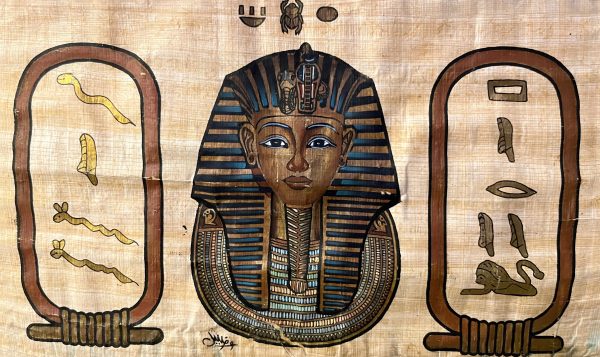
The Hidden Cartouche: Lifting a Broken Past to the Pedestal

The discovery. Raw, fragile, and held together by nothing but the truth of its message.
It started in the back of a dark closet. I found it there, nothing more than a crumpled, forgotten piece of papyrus. It was easy to overlook, tucked away like a secret no one was supposed to find.
I took it out, straightened the edges, and carefully mounted it. I thought I was just preserving a piece of art, but as I began to research the symbols, I realized I was actually decoding a message my mother had left behind—one that changed everything I thought I knew about our family.
For years, I believed there was a wall between my mother and my wife. My wife didn’t come from a “perfect” background; her story was one of foster homes, abandonment, and survival. I always felt my mother held that against her.
But the Cartouche told a different story.
In ancient Egypt, the Cartouche was reserved for those of the highest status, a circle of divine protection. When I finally understood the symbols, I saw the truth: my mother hadn’t excluded her. She had placed my wife on the exact same pedestal as me. Despite knowing every detail of her past—the foster care, the abuse, the struggle—my mother’s final “decree” was to honor her as my equal.
The secret message wasn’t a warning; it was a blessing of protection and a seat at the royal table.

The Pedestal. My mother’s decree, finally framed in the gold and blue it deserved.